Fire door checks for purpose-built blocks
The stair doors, the corridor doors, the cupboards and the flat fronts, with a written record you can show an inspector.
Get a priceThe first question about a block is how tall it is.
Measure from the ground floor to the floor of the top storey. If the residential building is over 11 metres, the Fire Safety (England) Regulations 2022 apply. If it is not, the Regulatory Reform (Fire Safety) Order 2005 still applies, but the fixed timetable does not.
What the regulations ask for over 11 metres
- Check the fire doors in the shared parts at least every three months
- Use best endeavours to check every flat entrance door at least every twelve months
- Tell residents, at least once a year, to keep fire doors shut, not to remove the closers and to report any damage
Buildings of at least 18 metres or seven storeys also need signs inside that help people find their way out. Those signs come under the same regulations.
Why "best endeavours" needs a record
Not every resident will answer the door. Some flats are sublet and the tenant has never heard of the managing agent.
If you cannot get in, you are expected to have tried properly. Keep the date of each attempt, who was written to and what they said.
We keep that log as part of the job. By the following year you know which flats are difficult and can start with them.
The doors in a typical block
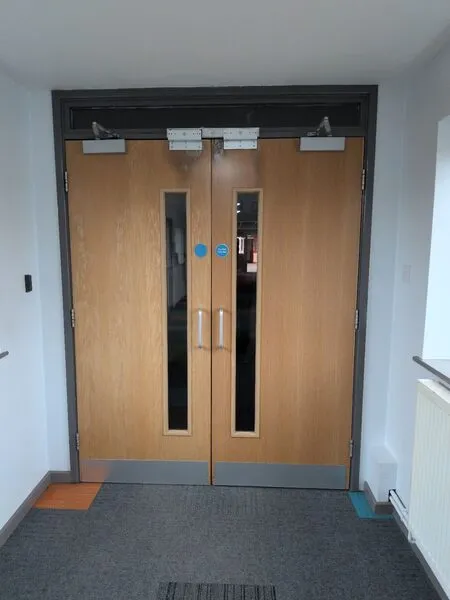
Stair doors on each landing, usually glazed, usually with a closer that has been adjusted by half a dozen different people.
Corridor doors that split a long landing into sections. Doors to bin stores and boiler rooms, which get banged and propped more than any others. Cupboard doors for risers and meters, which are normally locked, so a closer is not always needed on those.
Then the flat fronts. A purpose-built block of any age will have flat entrance doors in several designs, because they get replaced one at a time when a leaseholder pays for it.
Quarterly walks
The quarterly check is a short one. Open the door fully and let go. Open it a little and let go, because a closer that works from wide open can fail from a small angle. Look at the seals, hinges and glass.
A caretaker can do that if somebody shows them what to look for. A lot of managing agents would rather we did it, so we do.
A full inspection goes further. Gauges, labels, fixings and photographs. If a block has never had one, that comes first, because the quarterly walks only tell you what has changed since the last time.
Taller buildings
A building of 18 metres or seven storeys with at least two homes is also a higher-risk building under the Building Safety Act 2022. Door records need to fit alongside the other safety information kept for it. Tell us when you ask for a price and we will lay out the report to suit.
Work behind this page
34 fire doors repaired in a block of flats in Luton. Smoke seals fitted to flats in Stevenage.
Questions we get asked
My block has four floors. Is it over 11 metres?
Not necessarily. Floor heights vary. Get it measured.
Can you take over from another firm?
Yes. Send their last report and we will carry on from it.
Send the postcode and a rough number of doors. We will come back with a price the same day.
Get a price