Fire door inspections for offices, workshops and units
The doors staff use hundreds of times a week, checked and written up for the person responsible.
Get a priceWorkplace doors wear out for different reasons from the ones in flats.
In an office the busiest door is the one between the open floor and the stairs. It gets pushed, pulled and kicked open with a laptop bag in each hand. In a workshop it is the door to the yard that gets a trolley through it twenty times a day.
All of that shows up at the closer, the hinges and the bottom edge.
Who is in charge
If you run the business, or control the building, you are probably the responsible person under the Regulatory Reform (Fire Safety) Order 2005. If you rent a unit and the landlord looks after the shared parts, the duties are split, and it helps to find out in writing who does what.
The Order expects fire doors to be kept in good working order. It does not say an inspection must happen once a year. It does mean you have to be able to show the doors work, and an inspection with a record is the clearest way of doing that.
Where we look first
We start with the door from the work area to the escape stair, then the doors to plant rooms, server cupboards, stores and the kitchen.
After that, anything that is being held open. And anything that has been drilled for a card reader, a cable or a pipe.
Keypads and card readers
Access control is one of the commonest reasons a fire door fails. Somebody cuts a deep hole for a lock body or a cable, and the leaf is no longer what was tested.
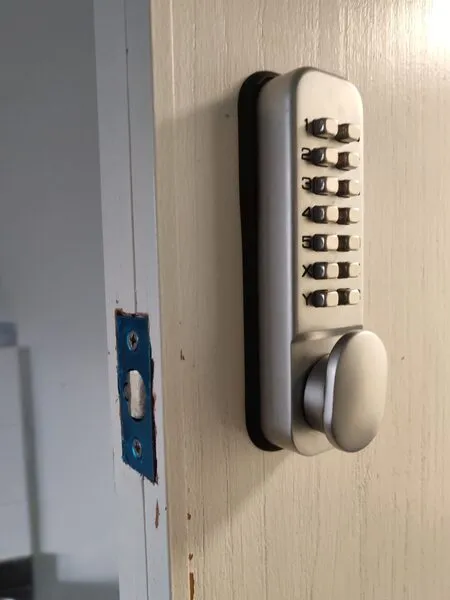
The photo on this page has a keypad lock screwed to the face of a door. The edge of the same door has been cut out for the latch. We note each of those cuts.
Then we ask the question that decides it. Does the door's maker allow that lock on that door? We look up both.
If you need to add access control to a fire door, ask before you drill.
Doors that stand open
Plenty of doors in working buildings are propped open because people are carrying things. Propping defeats the door completely.
There are proper ways to do it. A hold-open device linked to the alarm lets the door go when the alarm sounds. We have written a short answer on it, which you will find under straight answers on the home page.
Fire risk assessment
If you do not have a current fire risk assessment, you need one. It is a different piece of work. An inspection looks at the doors, the assessment looks at the whole building. We do not treat one as covering the other.
Work we can point to
A hotel in Reading where we surveyed 129 doors. Hotel doors never stop being used, and the wear was the same kind we find in a busy office.
Cost
A small building starts from around £250 plus VAT. Hours of access and whether the building is open while we work change the price. A unit that is empty on Sundays is quick.
Questions we get asked
We lease one floor. Are the stair doors ours?
Often not, but check your lease. If the landlord controls the shared parts they usually look after the stair doors. Ask in writing.
Can you inspect outside working hours?
Usually yes. Tell us when the building is empty and we will fit around it.
Send the postcode and a rough number of doors. We will come back with a price the same day.
Get a price